What Is a Signage BOQ?
BOQ stands for Bill of Quantities. In signage projects, it is the document that summarizes everything a fabricator needs to produce and install the signs. It differs from a sign schedule in scope:
| Document | Purpose | Detail Level |
|---|---|---|
| Sign Schedule | Lists every individual sign with location | Per-sign, per-location |
| Sign BOQ | Aggregates totals by type and specification | Per-type, summarized |
The sign schedule is created during the planning phase. The BOQ is derived from the schedule and used during procurement and fabrication.
What Goes Into a Signage BOQ?
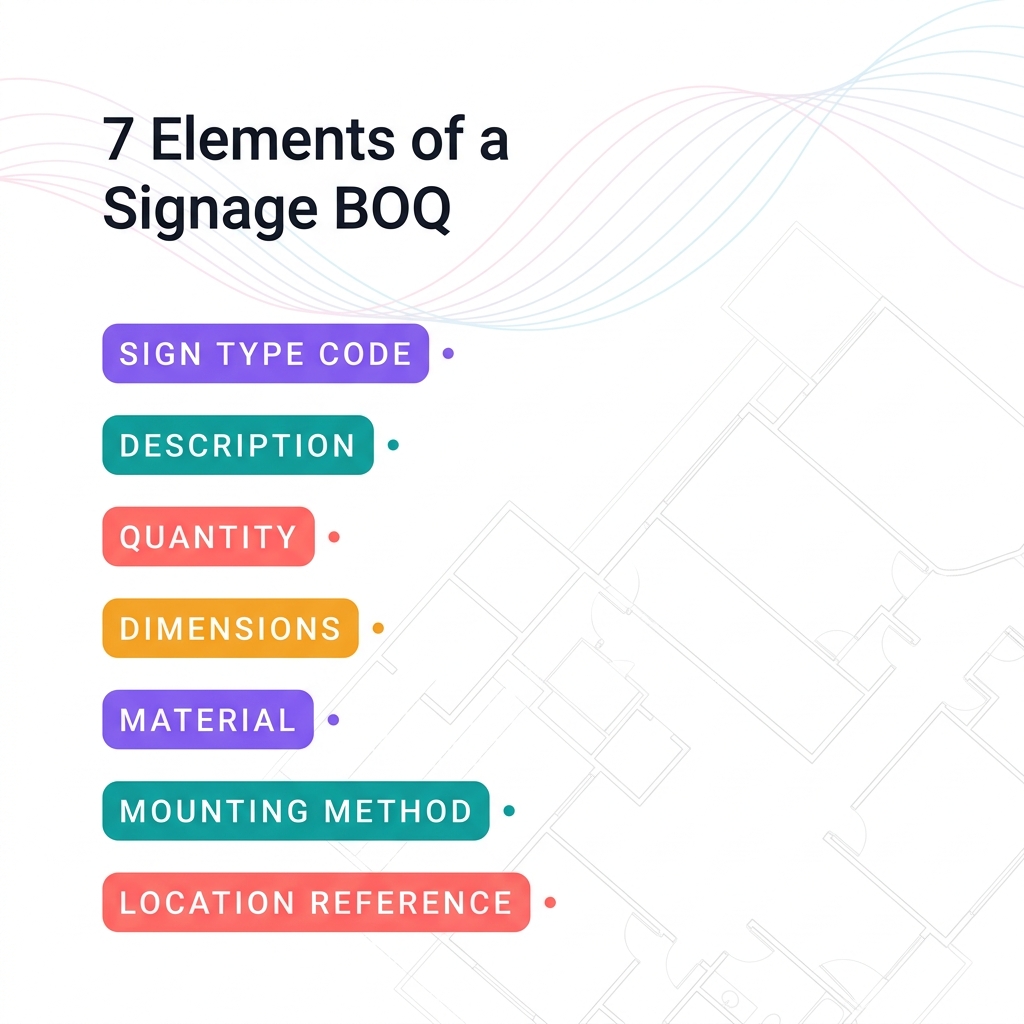
A complete signage BOQ typically includes:
- Sign type code — The classification identifier (e.g., D-01)
- Description — What the sign is and what it communicates
- Quantity — Total number of this sign type across the project
- Dimensions — Width, height, and depth
- Material — Substrate, finish, and colour
- Mounting method — Wall-mounted, ceiling-hung, freestanding, or recessed
- Location reference — Which floors or zones this sign type appears in
How to Create a Signage BOQ
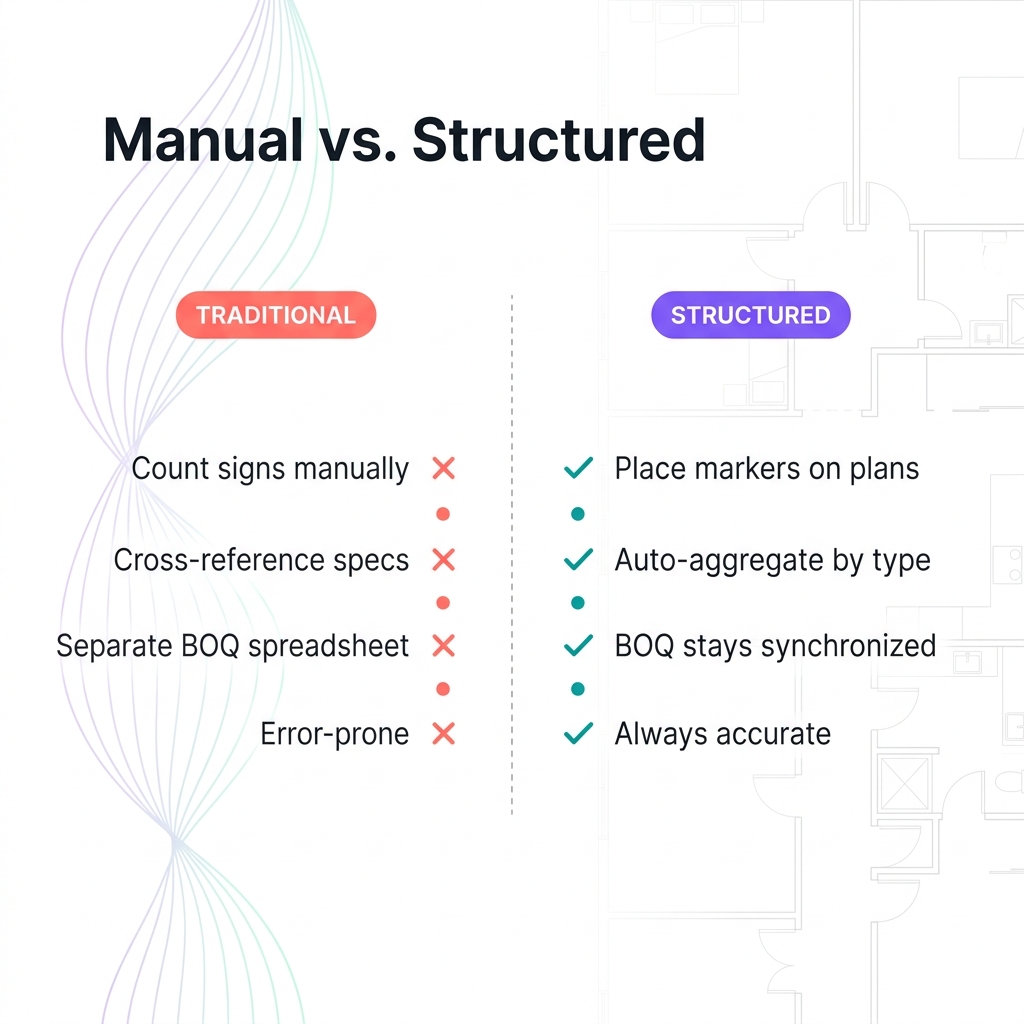
Traditional Method
- Complete the sign schedule in a spreadsheet
- Manually count each sign type across all floors
- Cross-reference with material specifications
- Create a separate BOQ spreadsheet with aggregated totals
- Send to fabricator for pricing
This process is error-prone. A missed sign in the schedule means an incorrect BOQ. A change in sign type requires manual recounting across every floor.
Structured Method
- Define sign categories and codes with material specifications
- Place sign markers on floor plans
- The system automatically aggregates placement data by type and generates the BOQ
No manual counting. No separate spreadsheets. The BOQ stays synchronized with the schedule as placements change.
Why Accuracy Matters
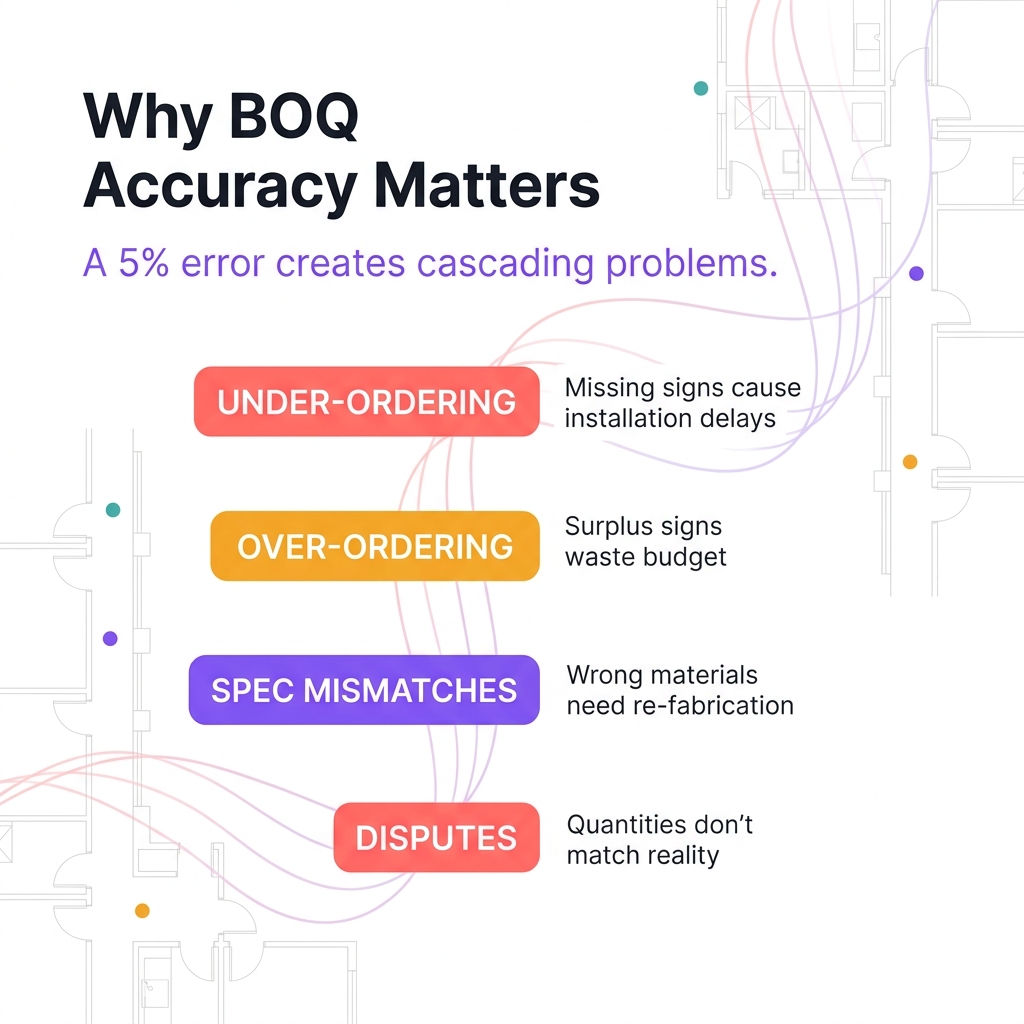
An inaccurate BOQ creates cascading problems:
- Under-ordering — Missing signs discovered during installation cause delays
- Over-ordering — Surplus signs waste materials and budget
- Specification mismatches — Wrong materials require re-fabrication
- Contractor disputes — Quantity disagreements when the BOQ doesn't match reality
In large-scale projects, even a 5% BOQ error can represent significant cost and timeline impact.
BOQ vs. Cost Estimate vs. Quote
These three documents serve different functions:
- BOQ — What is needed (quantities and specifications only)
- Cost estimate — What it will cost (unit prices applied to BOQ)
- Quote — What a specific fabricator will charge
A well-structured BOQ makes cost estimation and quoting accurate for all parties.